
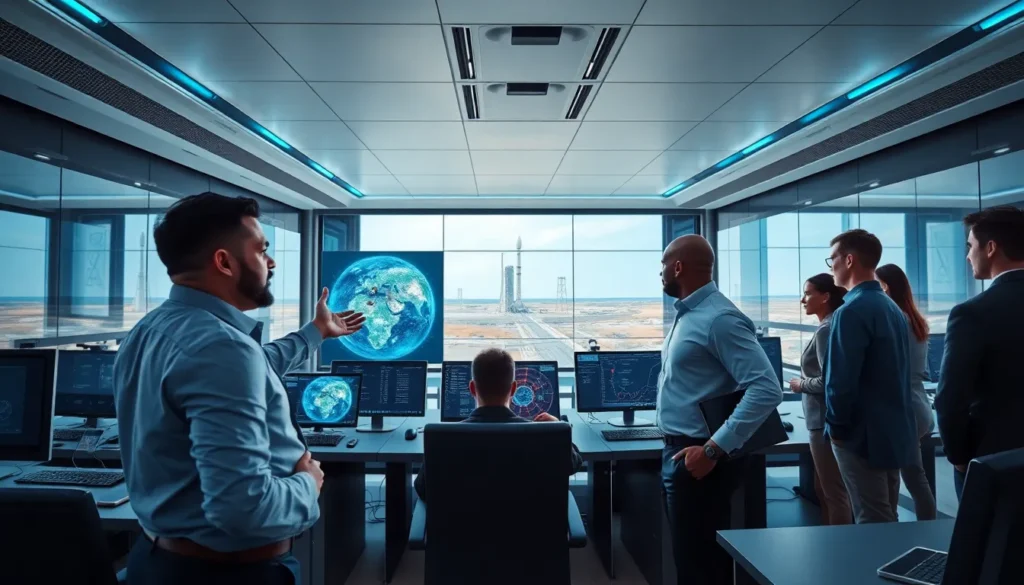
Space technology techniques define how humans explore, communicate, and observe beyond Earth’s atmosphere. These methods have transformed from early rocket experiments into sophisticated systems that power everything from GPS navigation to Mars rovers. Today, space agencies and private companies use a combination of propulsion systems, satellite networks, robotics, and remote sensing to push the boundaries of what’s possible. This article breaks down the core space technology techniques driving modern exploration, and the emerging innovations that will shape the next chapter of space travel.
Table of Contents
ToggleKey Takeaways
- Space technology techniques include satellite communication, propulsion systems, remote sensing, and robotics—each serving distinct roles in modern exploration.
- Ion and nuclear propulsion offer more efficient alternatives to chemical rockets, with NASA’s DRACO program aiming to cut Mars travel time in half by 2027.
- Remote sensing technologies like radar, LiDAR, and hyperspectral imaging provide critical data for climate monitoring, disaster response, and planetary exploration.
- Autonomous robotics, such as the Perseverance rover and Canadarm2, enable complex missions where human intervention is limited by distance or danger.
- Emerging space technology techniques like in-space manufacturing, in-situ resource utilization (ISRU), and quantum communication are paving the way for sustainable, long-duration space missions.
Satellite Communication and Navigation Systems
Satellite communication forms the backbone of modern space technology techniques. Spacecraft, astronauts, and ground control teams rely on these systems to exchange data across vast distances.
Communication satellites operate in three primary orbits: geostationary (GEO), medium Earth orbit (MEO), and low Earth orbit (LEO). GEO satellites stay fixed above one point on Earth, making them ideal for broadcasting and weather monitoring. LEO satellites, like those in SpaceX’s Starlink constellation, orbit closer to Earth and provide lower-latency internet connections.
Navigation systems represent another critical application. The Global Positioning System (GPS), operated by the U.S. Space Force, uses a constellation of at least 24 satellites to provide location data worldwide. Europe’s Galileo and Russia’s GLONASS offer similar capabilities. These systems enable everything from smartphone directions to precision landing for spacecraft.
Deep space communication presents unique challenges. NASA’s Deep Space Network (DSN) uses three large antenna complexes positioned around the globe to maintain contact with missions like Voyager 1, which is now over 15 billion miles from Earth. Signal delays can reach hours, so spacecraft must operate with significant autonomy.
Space technology techniques in satellite communication continue to advance. Laser-based optical communication, for example, can transmit data 10 to 100 times faster than traditional radio frequencies. NASA’s LCRD (Laser Communications Relay Demonstration) mission, launched in 2021, is testing this technology for future deep space missions.
Propulsion Technologies for Space Missions
Propulsion technology determines how far and how fast spacecraft can travel. Without effective propulsion, space technology techniques remain grounded.
Chemical propulsion remains the most common method for launching vehicles into orbit. Liquid-fuel rockets, like those used by SpaceX’s Falcon 9, combine liquid oxygen with kerosene or hydrogen. Solid rocket boosters, such as those on NASA’s Space Launch System, offer simplicity and high thrust but cannot be throttled or shut down once ignited.
Ion propulsion represents a more efficient alternative for long-duration missions. Instead of burning fuel, ion engines accelerate charged particles (ions) using electric fields. NASA’s Dawn spacecraft used ion propulsion to visit both the asteroid Vesta and the dwarf planet Ceres, a feat impossible with chemical rockets alone. Ion engines produce low thrust but can operate continuously for months or years.
Nuclear propulsion is gaining renewed attention. Nuclear thermal propulsion (NTP) heats hydrogen using a nuclear reactor, producing twice the efficiency of chemical rockets. NASA and DARPA are collaborating on the DRACO program to demonstrate NTP technology by 2027, with the goal of shortening Mars transit times from nine months to roughly four.
Solar sails offer a propellant-free option. They use pressure from sunlight to accelerate spacecraft. Japan’s IKAROS mission, launched in 2010, became the first successful solar sail spacecraft. The Planetary Society’s LightSail 2 demonstrated controlled solar sailing in Earth orbit.
These propulsion-based space technology techniques each serve different mission profiles. Chemical rockets excel at escape velocity. Ion engines shine in deep space. Nuclear and solar systems promise faster, more efficient exploration in the decades ahead.
Remote Sensing and Earth Observation Techniques
Remote sensing allows scientists to study Earth and other celestial bodies without physical contact. This category of space technology techniques has revolutionized climate science, agriculture, and disaster response.
Optical sensors capture visible light and near-infrared wavelengths. Satellites like Landsat (operated by NASA and USGS) have provided continuous Earth imagery since 1972. This data tracks deforestation, urban expansion, and crop health.
Radar sensors can see through clouds and darkness. Synthetic Aperture Radar (SAR) creates detailed surface images regardless of weather conditions. The European Space Agency’s Sentinel-1 satellites use SAR to monitor sea ice, oil spills, and ground deformation from earthquakes.
Thermal infrared sensors detect heat signatures. They identify wildfires, volcanic activity, and ocean temperature variations. NASA’s ECOSTRESS instrument on the International Space Station measures plant stress by tracking surface temperatures.
LiDAR (Light Detection and Ranging) uses laser pulses to create 3D maps. NASA’s ICESat-2 mission measures ice sheet thickness with centimeter-level precision. This space technology technique provides crucial data for understanding sea-level rise.
Hyperspectral imaging captures hundreds of narrow wavelength bands simultaneously. It can identify specific minerals, vegetation types, and even water quality from orbit.
Remote sensing extends beyond Earth. Mars orbiters use these same space technology techniques to map the Red Planet’s surface and search for water ice. The data guides rover landing site selection and future human mission planning.
Robotics and Autonomous Systems in Space
Robotics enables exploration where humans cannot yet go. These space technology techniques extend humanity’s reach to distant planets, moons, and asteroids.
Mars rovers showcase the power of autonomous systems. NASA’s Perseverance rover, which landed in February 2021, can drive itself using onboard cameras and hazard avoidance software. It identifies safe paths without waiting for Earth-based commands, essential when communication delays exceed 20 minutes.
Robotic arms perform critical tasks in orbit. The Canadarm2 on the International Space Station has captured visiting cargo spacecraft, moved astronauts during spacewalks, and assembled station components. It spans 17 meters and can handle payloads up to 116,000 kilograms.
Sample return missions rely heavily on automation. Japan’s Hayabusa2 collected samples from asteroid Ryugu and returned them to Earth in 2020. NASA’s OSIRIS-REx successfully retrieved material from asteroid Bennu and delivered it in September 2023. These spacecraft performed touchdown, collection, and departure sequences with minimal human intervention.
Autonomous rendezvous and docking represent another advancement. SpaceX’s Dragon capsules dock with the ISS automatically, using sensors and algorithms to align with precision.
Future space technology techniques will push robotics further. NASA’s VIPER rover will search for water ice at the lunar south pole. Concepts for robotic spacecraft maintenance, in-orbit assembly, and even autonomous mining operations are under development.
Artificial intelligence enhances these systems. Machine learning helps rovers classify rocks, optimize power usage, and plan science activities. As missions venture farther from Earth, autonomous decision-making becomes not just useful but necessary.
Emerging Techniques Transforming the Future of Space Exploration
New space technology techniques are reshaping what missions can achieve. Several innovations stand out as potential game-changers.
In-space manufacturing could reduce launch costs dramatically. Instead of lifting heavy components from Earth, spacecraft might 3D-print structures using raw materials found on the Moon or asteroids. NASA has tested 3D printing on the ISS, and companies like Relativity Space are developing fully printed rockets.
In-situ resource utilization (ISRU) aims to produce water, oxygen, and fuel from local materials. NASA’s MOXIE experiment on Perseverance successfully extracted oxygen from Mars’ carbon dioxide atmosphere. Scaling this technology could support human missions without Earth resupply.
Space-based solar power is gaining interest again. The concept involves collecting solar energy in orbit and beaming it to Earth via microwaves. China plans to test a prototype by 2028. Without atmospheric interference, orbital solar arrays could generate power continuously.
Advanced materials are enabling lighter, stronger spacecraft. Carbon fiber composites reduce weight. Heat-resistant ceramics protect vehicles during atmospheric entry. Self-healing materials could repair micrometeorite damage automatically.
Quantum communication promises unhackable data transmission. China’s Micius satellite has demonstrated quantum key distribution between space and ground stations.
These emerging space technology techniques share a common goal: making space more accessible and sustainable. As costs drop and capabilities increase, more nations and companies can participate in exploration. The techniques developed today will determine whether humanity becomes a truly spacefaring species.


