
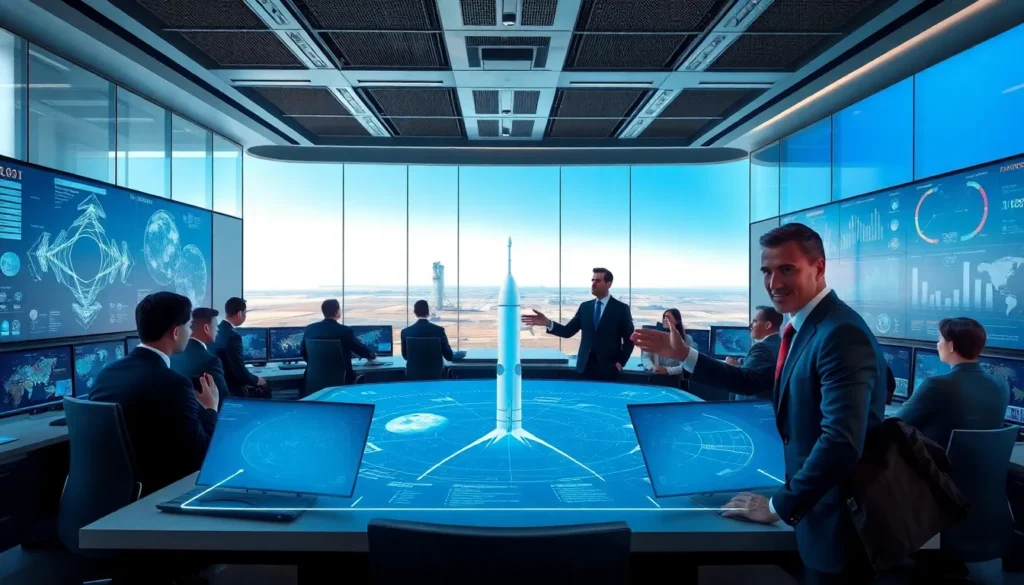
Space technology strategies define how nations and companies plan, develop, and deploy systems for exploring beyond Earth. These strategies shape everything from satellite launches to lunar missions and deep-space probes. In 2025, space exploration has entered a new phase. Government agencies now work alongside private companies. Reusable rockets have cut launch costs by over 90% in some cases. And the race to establish permanent human presence on the Moon and Mars has never been more competitive.
This article examines the key space technology strategies driving progress today. It covers historical development patterns, strategic pillars guiding modern programs, partnership models, and sustainability practices. Whether a reader works in aerospace or simply follows space news, understanding these strategies reveals how humanity plans to become a multi-planetary species.
Table of Contents
ToggleKey Takeaways
- Modern space technology strategies combine government oversight with private-sector innovation, dramatically reducing launch costs and accelerating mission timelines.
- Reusable rockets have slashed launch costs by over 90%, making more space missions financially viable than ever before.
- Public-private partnerships like NASA’s Commercial Crew Program save billions while distributing risk and combining expertise across organizations.
- Core strategic pillars include launch cost reduction, in-space resource utilization, autonomous AI systems, and modular standardized architectures.
- Sustainability is now central to space technology strategies, with debris mitigation plans and green propulsion alternatives becoming standard requirements.
- Long-term mission success depends on flexible architectures, clear milestones, and commercial incentives that can survive political and funding changes.
The Evolution of Space Technology Development
Space technology strategies have changed dramatically since the Space Race era. In the 1960s, governments controlled nearly all space activity. NASA and the Soviet space program competed for national prestige. Cost was secondary to speed and achievement.
The Space Shuttle program marked a shift toward reusability, though it never achieved the cost savings originally promised. Still, it proved that spacecraft could return and fly again. This concept would later become central to modern space technology strategies.
The 2000s brought a fundamental change. SpaceX launched its first Falcon 1 rocket in 2008. By 2015, the company had successfully landed a Falcon 9 booster. This achievement demonstrated that private companies could innovate faster than government programs in certain areas.
Today’s space technology strategies blend government oversight with commercial innovation. NASA’s Artemis program relies on SpaceX’s Starship and Blue Origin’s Blue Moon lander. The European Space Agency partners with Arianespace and newer players. China’s CNSA has developed its own independent capabilities while also seeking international cooperation.
Three trends define current strategy evolution:
- Commercialization: Private companies now handle routine launches, freeing agencies to focus on deep-space missions
- Miniaturization: CubeSats and small satellites enable more missions at lower costs
- International cooperation: Even rival nations share data on space weather and debris tracking
The evolution of space technology strategies reflects broader lessons about innovation. When competition and collaboration work together, progress accelerates.
Core Strategic Pillars in Modern Space Programs
Modern space technology strategies rest on several core pillars. These principles guide decision-making across agencies and companies worldwide.
Launch Cost Reduction
Reusable rockets have transformed the economics of space access. SpaceX’s Falcon 9 can launch payloads for roughly $2,700 per kilogram, down from $54,500 per kilogram on the Space Shuttle. This cost reduction makes more missions financially viable.
Rocket Lab, Relativity Space, and other companies pursue similar strategies. Some focus on 3D-printed components. Others develop new propellants. All share the goal of making space access affordable.
In-Space Manufacturing and Resource Utilization
Future missions can’t carry everything they need from Earth. Space technology strategies now prioritize in-situ resource utilization (ISRU). NASA’s MOXIE experiment on Mars produced oxygen from the Martian atmosphere. Future systems could extract water ice from lunar craters.
In-space manufacturing offers another path forward. Companies like Varda Space Industries plan to manufacture pharmaceuticals and semiconductors in microgravity.
Autonomous Systems and AI
Deep-space missions face communication delays of minutes or hours. Spacecraft must make decisions independently. Modern space technology strategies invest heavily in autonomous navigation, hazard avoidance, and scientific data prioritization.
NASA’s Perseverance rover uses AI to select rock samples. Future missions to Europa or Titan will rely even more on autonomous decision-making.
Modular and Standardized Architectures
Standardization reduces costs and speeds development. The International Space Station uses standardized docking ports. New lunar Gateway station will follow similar principles. This strategic approach allows components from different nations and companies to work together.
Public-Private Partnerships and Collaboration Models
The most successful space technology strategies today leverage public-private partnerships. These arrangements combine government funding and oversight with private-sector efficiency and innovation.
NASA’s Commercial Crew Program exemplifies this model. Rather than building its own spacecraft, NASA paid SpaceX and Boeing to develop crew capsules. NASA set requirements and provided funding. The companies retained ownership and could sell services to other customers.
This approach saved NASA billions of dollars compared to traditional cost-plus contracts. SpaceX’s Dragon capsule now regularly ferries astronauts to the ISS. Boeing’s Starliner finally completed its first crewed flight in 2024 after delays.
Types of Partnership Models
Fixed-price contracts: Companies agree to deliver specific capabilities for a set price. They absorb cost overruns, creating incentive for efficiency.
Space Act Agreements: NASA can partner with companies without traditional procurement rules. These agreements enabled Commercial Orbital Transportation Services (COTS) and similar programs.
International cooperation: The Artemis Accords establish principles for lunar exploration. Signatory nations agree on resource rights, heritage site protection, and debris mitigation.
Commercial services: Rather than owning assets, agencies can purchase services. NASA buys cargo delivery to the ISS. It plans to purchase commercial space station services after ISS retirement.
Space technology strategies increasingly recognize that no single organization can do everything. Partnerships distribute risk, combine expertise, and accelerate timelines. The lunar Gateway station will include modules from NASA, ESA, JAXA, and CSA, each contributing specialized capabilities.
Sustainability and Long-Term Planning in Space Missions
Effective space technology strategies must address sustainability. This means both environmental responsibility and mission longevity.
Orbital Debris Management
Over 36,000 objects larger than 10 centimeters orbit Earth. Millions of smaller fragments pose collision risks. A single impact could trigger cascading collisions, the Kessler syndrome, that could make certain orbits unusable.
Space technology strategies now include debris mitigation from the design phase. Satellites must have deorbit plans. Some companies develop active debris removal systems. The European Space Agency’s ClearSpace-1 mission will demonstrate debris capture technology.
Sustainable Propulsion
Traditional rocket propellants create environmental concerns. Hypergolic fuels are toxic. Solid boosters release harmful particles. Green propellant alternatives are gaining adoption.
Electric propulsion systems offer efficiency for in-space maneuvering. Solar sails and other propellantless technologies could enable missions that would otherwise be impossible.
Long-Duration Mission Planning
Missions to Mars take years. Establishing permanent lunar presence requires decades of commitment. Space technology strategies must account for political changes, funding fluctuations, and technology evolution.
Successful long-term strategies build flexibility into architectures. They establish clear milestones that demonstrate progress. And they create commercial incentives that survive government priority shifts.
The Artemis program learned from earlier efforts. It uses commercial partnerships to reduce government costs. It establishes international commitments that create diplomatic pressure for continuation. And it designs systems with multiple potential uses, the Gateway station could support lunar surface operations, asteroid missions, or Mars preparation.


